


A few years ago, artificial intelligence in web design meant little more than a chatbot bolted onto a homepage. That's changed fast. AI is now woven through nearly every stage of building a website — from the first sketch of an idea to the code that runs it and the way it adapts to each visitor who lands on it. So where is this heading, and what does it actually mean for your business?
At Pennine Websites, we build websites for UK businesses and nonprofits and use AI as part of our process. Here's our honest take on where the technology is going — and where it isn't.
Websites that adapt to each visitor
One of the biggest shifts is personalisation. Rather than every visitor seeing an identical homepage, AI can analyse behaviour in real time and adjust what's shown — which products are highlighted, which message appears first, which call to action is offered — based on how someone is browsing. For a retailer, that might mean showing different featured products to a first-time visitor versus a returning customer. For a charity, it might mean surfacing a donation appeal to an engaged reader and a volunteering page to someone browsing from a local search.
This kind of adaptive design used to require large budgets and dedicated data teams. It's increasingly accessible to much smaller organisations, which is a genuine opportunity for UK small businesses to compete with much bigger players online.
Faster development, without cutting corners
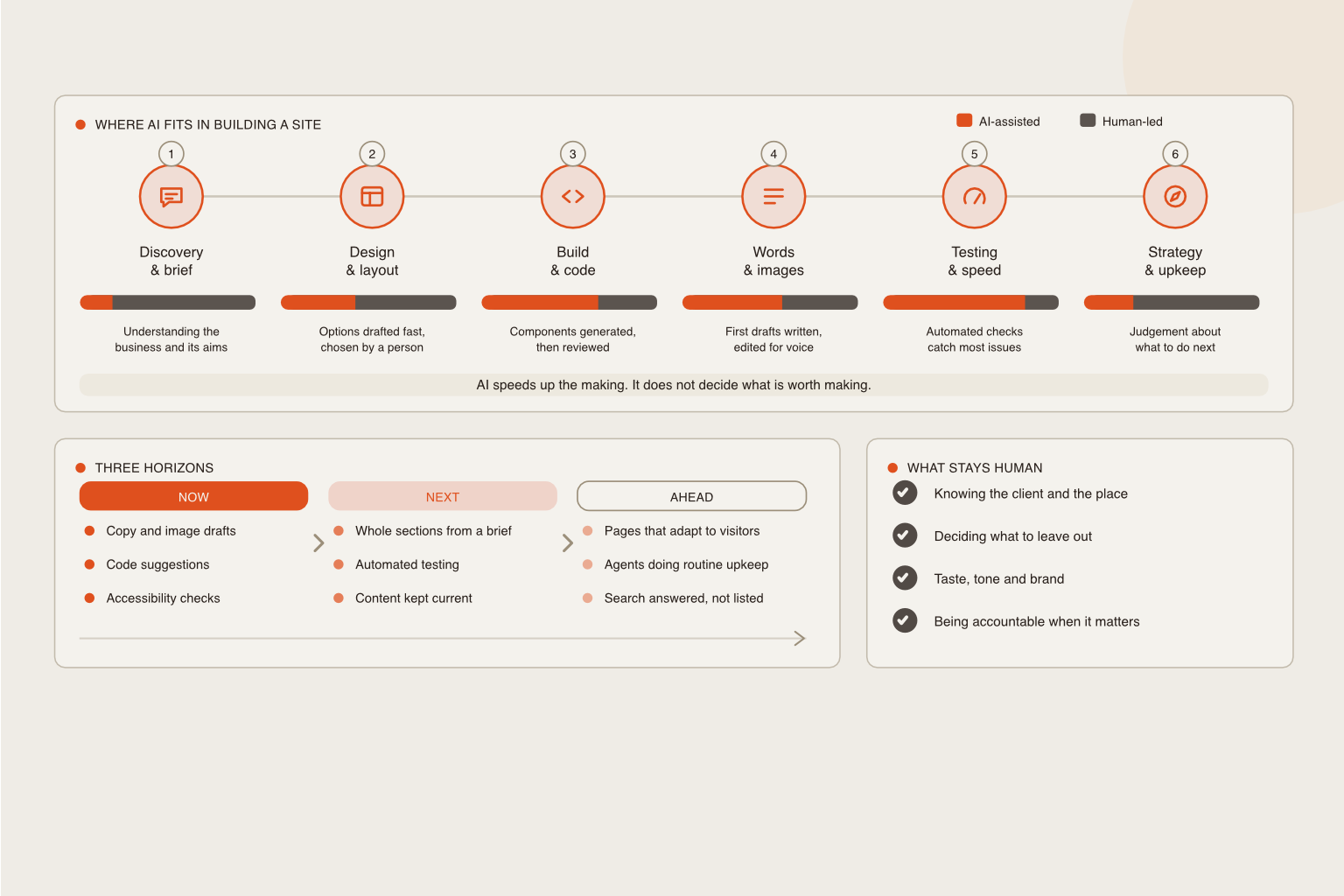
AI is also changing how websites get built behind the scenes. Tasks that used to eat up hours — writing boilerplate code, testing across devices, catching bugs, generating design variations — can now be done in a fraction of the time with AI assistance. That doesn't mean websites are being built by AI alone. It means the repetitive, mechanical parts of the job are handled faster, freeing up time for the parts that actually need a human eye: understanding your business, your customers, and what will genuinely make your site work harder for you.
The practical upshot for clients is websites that are built more efficiently, tested more thoroughly, and often more affordably than a few years ago — without sacrificing quality.
Smarter content, written for people and for search
AI tools are now capable of drafting, refining and testing website copy against real searcher intent, and of helping structure content so it performs well both in traditional search engines and in the newer AI-powered search tools like Google's AI Overviews, ChatGPT and Perplexity. Websites that are clearly written, well-structured and genuinely useful are increasingly the ones that get found and recommended — by people and by AI alike.
Design that responds, not just displays
Looking ahead, expect websites to become less static. Layouts that reorganise themselves for accessibility needs, interfaces that respond to how a visitor is actually behaving, and design suggestions generated and tested automatically are all becoming more common. The website of the near future won't just be a fixed set of pages — it'll behave more like a responsive system that's constantly being fine-tuned.
What AI won't replace
It's worth being honest about the limits, too. AI is very good at generating options, spotting patterns and speeding up production — it is not good at understanding your business, your customers, your brand, or what genuinely matters to the people you serve. Good web design still requires judgement: knowing which of ten AI-generated options is actually right for your audience, knowing when a "best practice" doesn't fit your organisation, and knowing how to translate a conversation with a client into a website that reflects who they really are.
The websites that will stand out over the next few years won't be the ones that used AI the most. They'll be the ones where AI-driven efficiency was combined with real human judgement — fast where speed matters, careful where it counts.
How we're using this at Pennine Websites
We've built AI into our own workflow — for research, content, technical audits and day-to-day efficiency — precisely so we can spend more time on the things that make a real difference to your website: understanding your business, thinking through your customer's journey, and making design decisions a machine can't make on its own. The result is websites built faster and priced more sensibly, without losing the craft.
Curious what this could mean for your website?
Whether you're building a new site or wondering if your current one is keeping pace, we're happy to talk through where AI genuinely helps — and where it doesn't.
Does Google like AI in its search results?
Google's official position is that it doesn't matter how content is produced — what matters is whether it's genuinely helpful. Its guidance has been consistent since 2023 and remains so in 2026: Google rewards content that demonstrates real expertise, original insight, and usefulness to the reader, whether a human or an AI helped write it. Studies analysing thousands of ranking pages have found AI-assisted content ranks in the top 10 at roughly the same rate as purely human-written content, which suggests Google's algorithms genuinely aren't sorting by "who typed this."
What Google does actively penalise is content produced at scale purely to game rankings — thin, repetitive pages churned out with little regard for whether they actually help anyone, AI-written or not. That's covered under Google's "scaled content abuse" policy, and it applies equally to mass-produced human content and AI content alike. The practical takeaway for businesses is simple: using AI to speed up research, drafting or optimisation is fine and increasingly normal, but the content still has to be accurate, well-structured, and written with the reader's actual question in mind. Production method isn't the issue; quality and intent are.
Get in touch for a friendly, no-obligation chat about your website.
Pennine Website Design & Development is a freelance web design and development service based in Barnard Castle, Teesdale. We build bespoke, high-performance websites for businesses and non-profits across the North East.
Get in touch | View our work | See pricing
James McBain