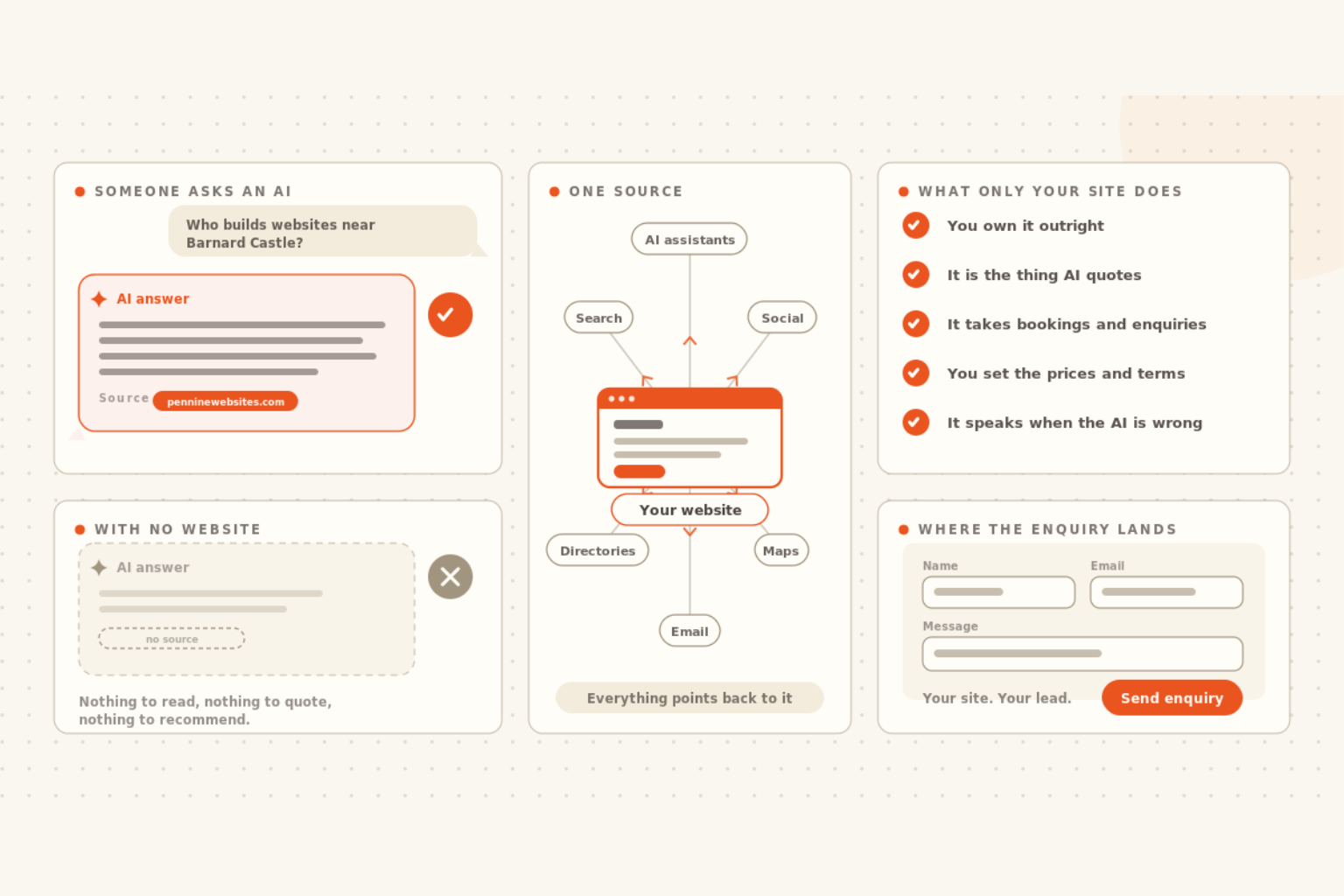

AI tools don't invent facts about your business out of thin air. They gather information from across the web - and the most reliable source of information about your organisation is the one you control: your own website. If it's clear, accurate and well-structured, AI has good material to work with. If it's missing, outdated or confusing, the AI is left to guess, or to rely on third-party listings and old reviews you have no say over.
Without a website, you leave your business story to everyone else. With one, you can tell it yourself - accurately, in your own words.
Speaking the language AI understands
People read websites visually. Machines read them differently. To help search engines and AI tools understand a page, websites can include structured data using the open Schema markup standard - a shared vocabulary that labels information in a way machines can read without guessing. It tells them, in black and white: this is a business, this is its name, this is its address and opening hours, these are the services it offers, this is a review, this is an event, this is an FAQ.
We build every website at Pennine Websites in Webflow, with structured Schema markup data built in. That gives search engines and AI tools clean, consistent, machine-readable facts about your organisation alongside the page your visitors see.
A note on honesty
It's worth being clear about what structured data can and can't do. Google, OpenAI and others haven't promised that adding schema markup will guarantee your business is mentioned or recommended by AI, and anyone who tells you otherwise is overselling. What it does do is remove ambiguity: it makes it easier for machines to understand who you are and what you offer, and it is a well-established part of good technical SEO. Combined with clear content and a site AI crawlers can actually reach, it gives you the best possible chance of being represented correctly.
Then the website does the rest of the job
Here's the part AI can't replace. When an AI tool mentions your business and a potential customer wants to know more, where do they go? Your website. It's the place that provides the full picture: your services in detail, your prices or how to enquire, your story, your photographs, your testimonials, your contact form. An AI summary might get someone interested; your website is what turns that interest into an enquiry, a booking or a donation.
Think of it as a partnership. The structured data tells the AI who you are. The visible website tells the visitor everything they need to decide. Both work from the same source of truth - yours.
What this means for your organisation
A website built for the age of AI should do a few things well:
- State the essentials clearly. Who you are, what you do, where you operate and how to get in touch - on the page, in plain English.
- Use structured data. Schema.org markup that matches what's visible on the page, so humans and machines see the same facts.
- Stay accurate and up to date. Opening hours, services and prices that are wrong in one place will be repeated wrong everywhere.
- Be fast, accessible and easy to crawl. If a tool can't reach or read your pages, it can't report on them.
- Give visitors everything they need. When someone arrives from an AI answer, the site should finish the job.
Is your website ready?
If your site is old, thin on detail or has no structured data, AI tools may be describing your business from scraps - or not mentioning you at all. The good news is that it's easy to fix.
At Pennine Websites, we design and build Webflow websites for UK businesses and nonprofits, with structured data included as standard, so that both people and AI get the right information about you.
Get in touch for a free, friendly review of how your website looks to AI.
Pennine Website Design & Development is a freelance web design and development service based in Barnard Castle, Teesdale. We build bespoke, high-performance websites for businesses and non-profits across the North East.
Get in touch | View our work | See pricing
Jamie McBain